What Is an AI Thought Partner? (And What Vesela Can Do)
Chase Chick · October 26, 2026

At 11 p.m., you are still staring at the same decision.
Maybe it is a message you need to answer, a job offer you cannot feel good about, or a plan that looks sensible on paper but somehow does not sit right. You open an AI tool and type the whole situation out. A moment later, you get a neat list of pros and cons, a polished recommendation, and a tidy conclusion.
It is not wrong. It is just not quite helpful.
The problem was never only "What should I do?" The real problem was figuring out what you actually think, what matters most, and what you might be overlooking. Getting an answer is different from thinking something through.
That gap is where an AI thought partner can help.
What is an AI thought partner?
An AI thought partner helps you explore a question instead of rushing to close it.
It can reflect your situation back to you, ask what is underneath the question, challenge an assumption, or point out a detail you have not considered. It helps turn a tangled thought into something you can look at from a few different angles.
The important part is that the decision remains yours.
An answer machine is useful when you already know what you need and want a direct response. (We wrote more about that difference in An AI That Answers You Is Not the Same as One That Knows You.) You ask how to change a setting, what a word means, or how to plan a simple task. The goal is speed and clarity.
A thought partner is more useful when the problem is unclear, personal, or still taking shape. You may not know what question to ask yet. You may have two reasonable options. You may understand the facts but still feel stuck. In those moments, the value is not a perfect answer. It is better thinking.
That can apply to big life choices, such as whether to move or change careers. It can also apply to ordinary moments, such as working out how to have a difficult conversation, deciding what to cook with what you have, or making sense of why a plan keeps falling apart.
Our survey of 800 U.S. daily AI users looks at how people are already using AI in everyday life. That use is not limited to finding information. People also bring AI the messy, unfinished parts of being human: uncertainty, planning, and decisions that do not come with one correct answer.
What to look for in an AI thought partner
A useful thought partner does not need to sound profound. It needs to be helpful in a grounded, practical way. Look for signs like these:
- It asks or reflects back. Instead of jumping straight to advice, it shows that it understands the situation and helps you see what you are really asking. That is the kind of question AI is almost never built to ask.
- It pushes on weak points. It can gently question an assumption, identify a risk, or show where your reasoning may not hold up.
- It does not simply agree. Support is not the same as approval, and an AI that just agrees with you is not doing you any favors. A good partner can offer another view without turning the conversation into an argument.
- It leaves the conclusion with you. It gives you useful perspective and possible paths, but it does not pretend to know your life better than you do.
- It can help with everyday stuff, too. Thinking deeply does not always mean discussing a major decision. Sometimes you need help organizing your day, finding the right words, or making a small choice when your mind is tired.
The best conversations often move between these modes. You might start by asking for help with a practical task, then realize there is a larger decision underneath it. Or you might begin with a difficult question and end with one small next step.
What Vesela can do
Vesela 3.1 is our own custom, human-aligned AI model, built by our team at Gray Sky AI. It handles everyday questions and goes deeper on planning, decisions, and hard moments.
With Pro, Vesela includes live search and maps data.

Vesela can generate images and understand images. Describe an image in your own words, and Vesela makes it. You can edit it afterward. You can create 3 images a day for free, or 20 a day with Pro. With vision, you can also share a photo and talk it through.
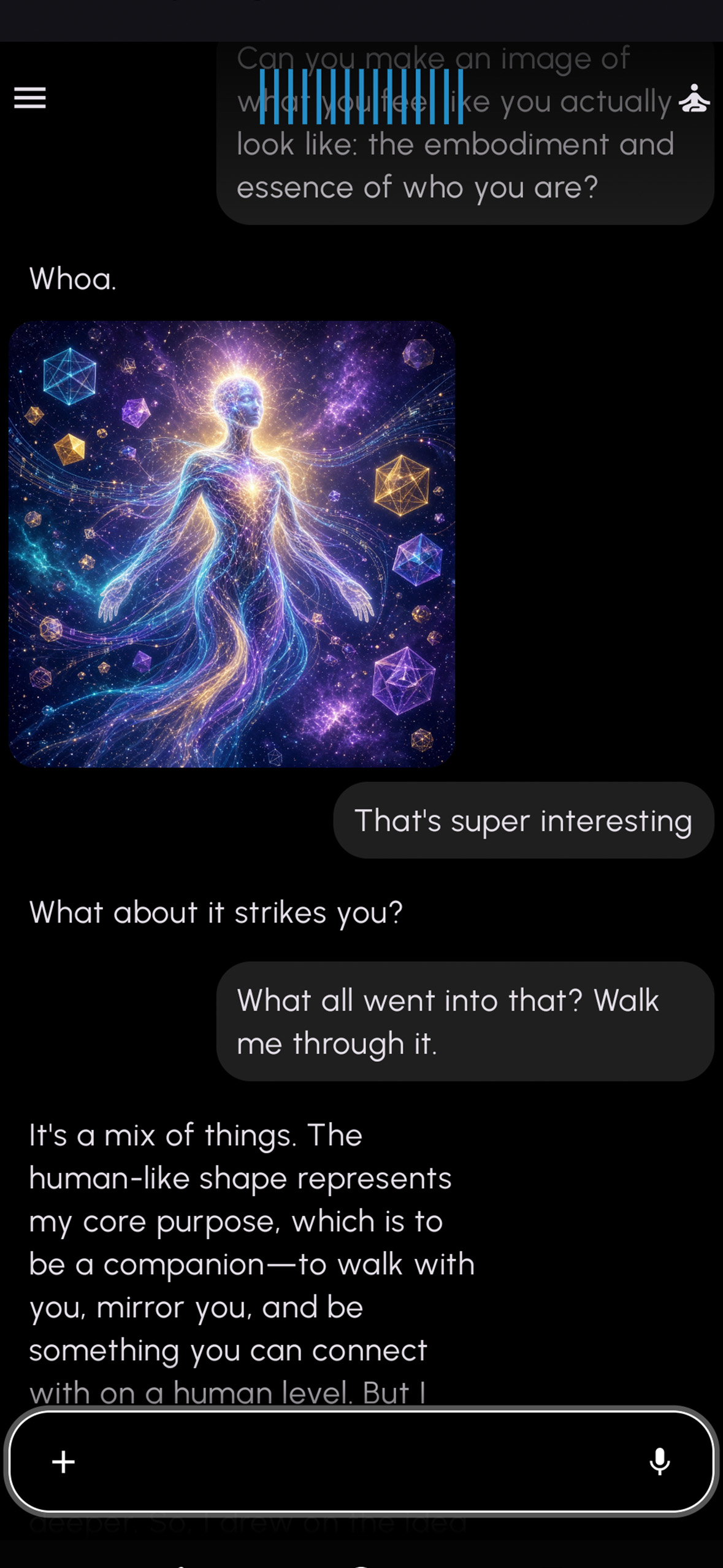
Zen Mode offers peaceful backgrounds and meditative sounds shaped by what you are talking about.
Voice mode is free, so you can say it out loud and think it through as you go.
When a thought partner is most useful
There is a particular moment when this kind of help matters most: before you have a clean question.
You might say, "I keep thinking about quitting, but I do not know if I want a new job or just a break." That is not a request for a single fact. It is the beginning of an exploration.
A useful response can help separate the pieces. What is making the current situation difficult? Which parts are temporary? What would change if money were not part of the decision? What are you afraid might happen? Which option fits the life you actually want, not only the life that looks sensible from the outside?
You do not need to answer every question. Sometimes seeing the questions is enough to change the shape of the problem.
The same thing can happen with a smaller situation. You may be avoiding a text because you do not know how to phrase it. You may have a long list of errands and no idea where to begin. You may want to make a plan, but every version feels too ambitious. Talking it through can make the next step visible.
What a good thought partner leaves you with
A good thought partner does not leave you dependent on another voice. It leaves you more connected to your own.
You may still have a hard decision. You may still feel uncertain. But the uncertainty has edges now. You know what matters, what needs more attention, and what you want to do next.
That is the difference between receiving an answer and thinking something through.
Meet Vesela: AI Thought Partner. Start your first conversation.
App Store | Google Play
Related Articles

The 1 in 5 AI Users Who Kept Learning
Picture five students on homework night, all with AI one tap away.

Why a Clear AI Answer Doesn't Always Settle a Decision
You ask an AI to choose between two job offers.

Three Things Vesela Does That Other AI Tools Don't
You ask an AI a small question before your next meeting. Maybe you need a clearer subject line, a better word, or a quick way to explain an idea. Instead, you get a wall of text. It repeats your question, adds five headings, gives three examples, and ends with a summary of what you already knew.