AI Might Not Come for Your Job, but it Might Be Coming for Your Judgment
Chase Chick · October 13, 2026

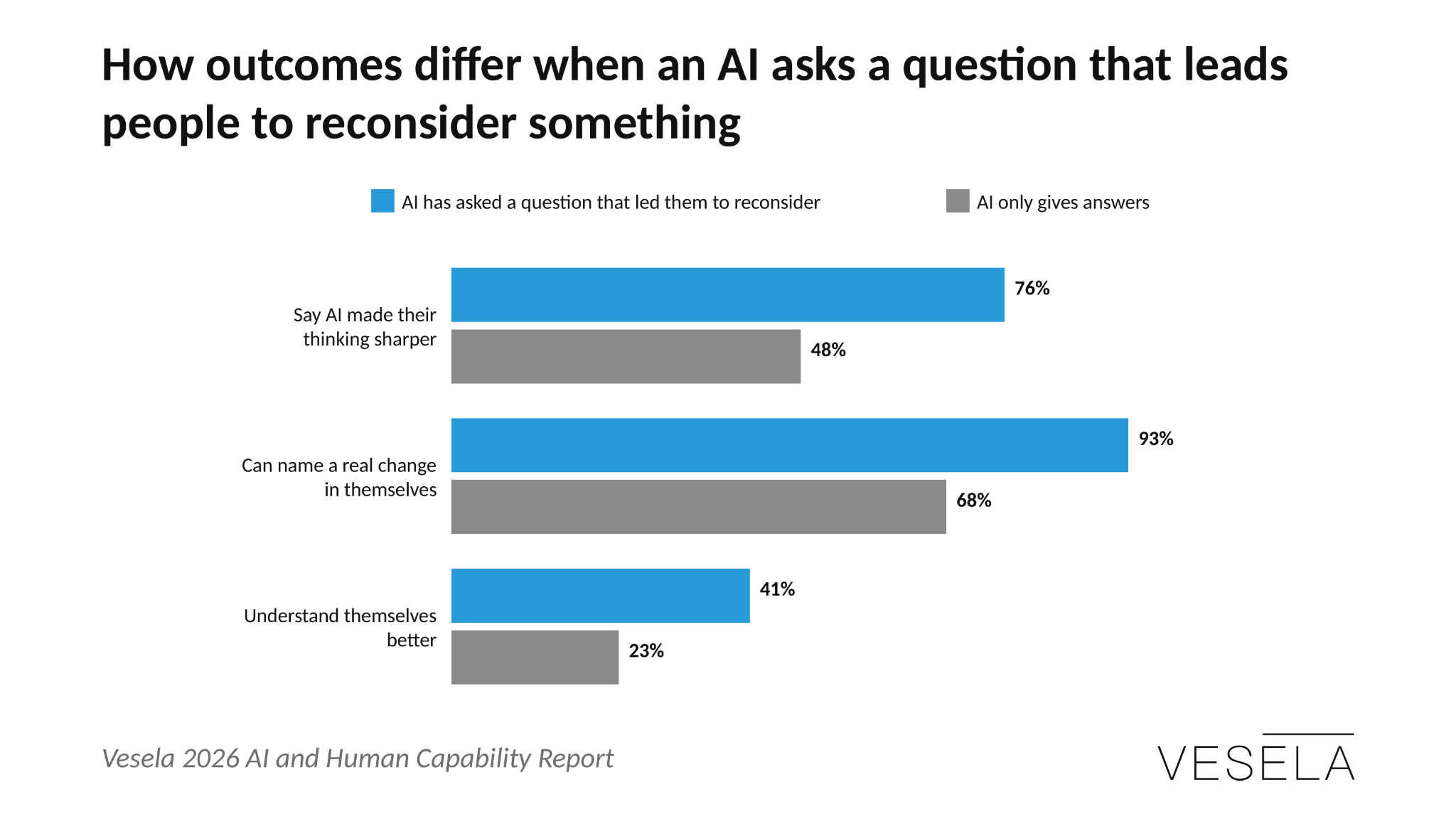
76% of daily AI users whose AI has challenged their thinking say it made their thinking sharper, against 48% of those whose AI has not.
The argument about AI and human ability usually has two sides. Either these tools make people more capable, or they make people worse at things they used to do for themselves.
The industry has spent the past two years answering a specific question: how much a model can get right, and how fast. Every few months, a new model arrives that is better at math, coding and science than the last, and the products built on them can increasingly finish a task start to finish on their own.
But those measures tell us much more about the model than the person using it. Meanwhile, AI is becoming part of decisions, learning and conversations that people once worked through on their own.
When OpenAI retired GPT-4o in February 2026, roughly 800,000 people were still using it, and the ones who objected were not arguing that the replacement model was less capable. They had gotten used to its warmer, more conversational style and did not want to lose it.
Many people are already using AI for far more than quick answers. They bring it into their personal decisions and turn to it when working through situations involving friends and family. As AI takes on a larger role in those parts of life, the question is no longer only what the technology can do, but what its use may be changing in the people who rely on it.
About the Vesela 2026 AI and Human Capability Report
The Vesela 2026 AI and Human Capability Report explores what daily AI use is doing to people’s own capability, including what they believe AI has done to their thinking, which tasks and decisions they have handed over, how AI has entered their personal relationships, and what they want from AI that they are not getting today.
In September 2026, Gray Sky AI partnered with the third-party survey platform Pollfish to conduct an online survey of 800 U.S. adults who use an AI chatbot or assistant for personal, non-professional reasons at least once a day. Gray Sky AI is the company behind the human-aligned AI model Vesela, designed to help users think through problems and arrive at their own answers rather than simply providing one.
Key Findings of the Vesela 2026 AI and Human Capability Report
- Among people whose AI has prompted them to reconsider something, 76% say their thinking has gotten sharper. That falls to 48% among those whose AI has never challenged their thinking.
- Among people whose AI has prompted them to reconsider something, 93% can name something about themselves that actually changed. That falls to 68% among those whose AI has never challenged their thinking.
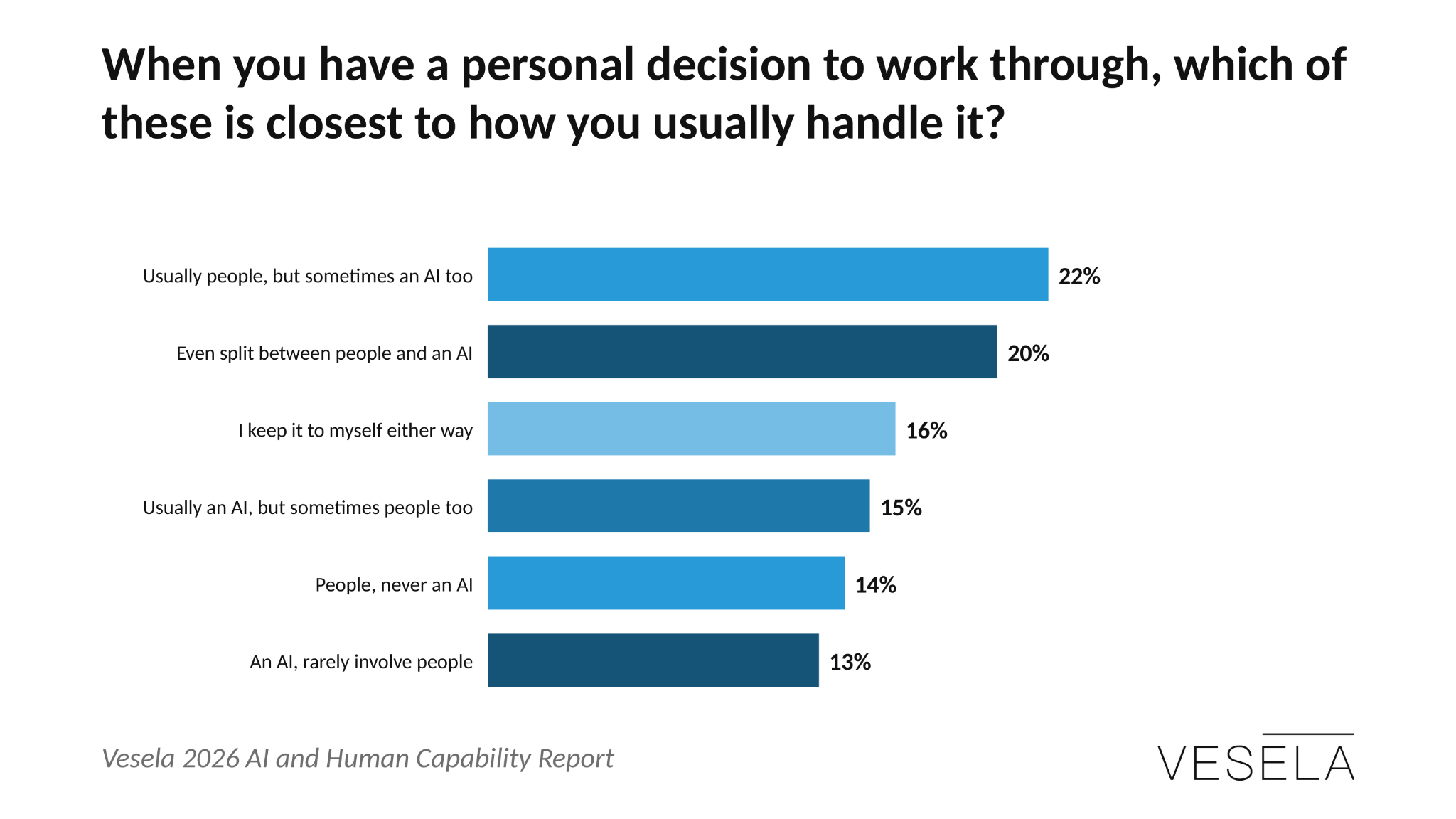
- 70% now involve AI in personal decisions like a job offer, a move, or a problem with someone close to them.
- 13% work through personal decisions with an AI and rarely involve another person at all.
- 53% say that when AI was no help with something personal, it went along with them instead of engaging them.
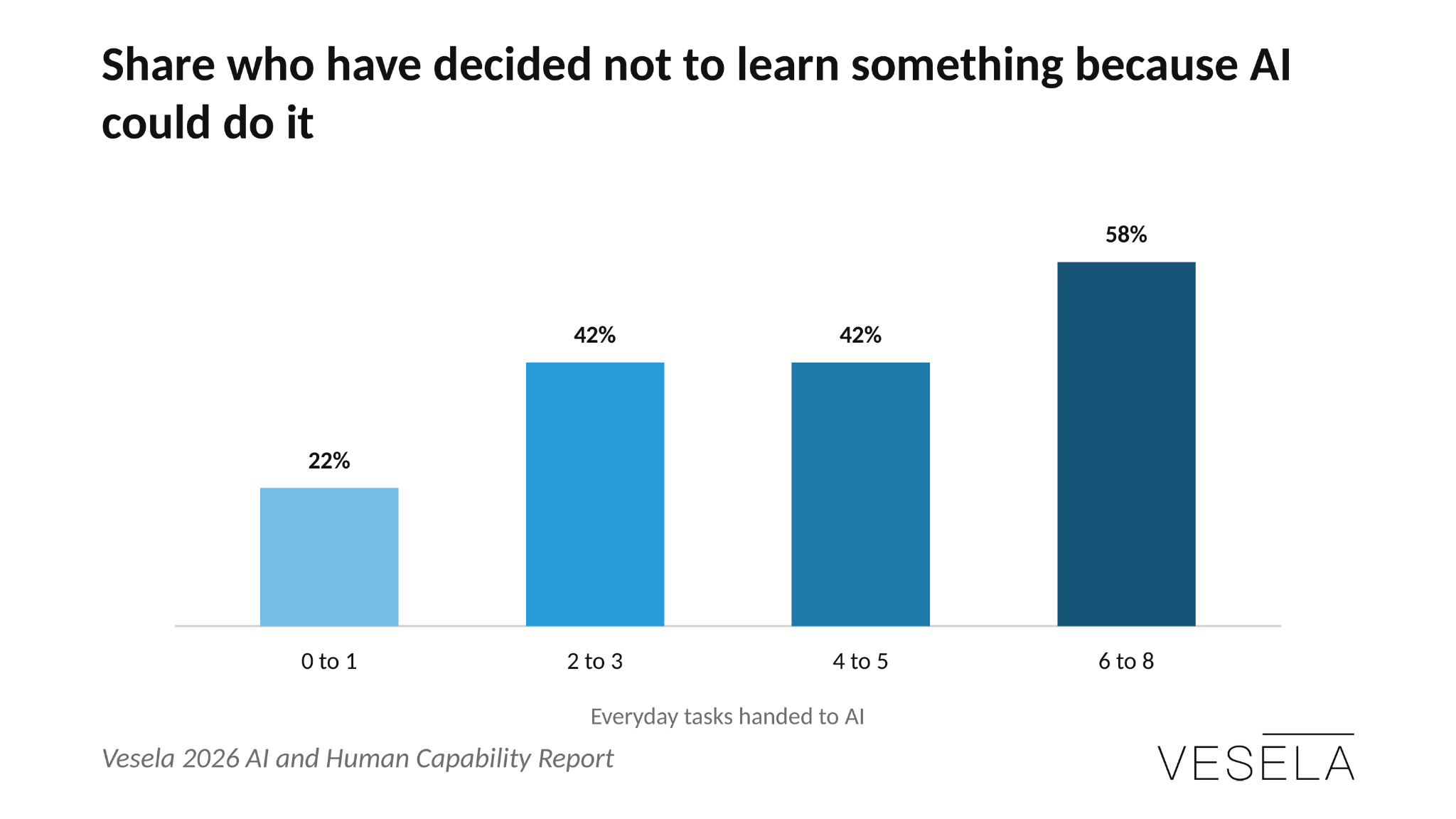
- 58% of the heaviest AI users say they have skipped learning something because AI could do it for them, compared with 22% of the lightest users.
- Only 19% would want a teenager in their life using an AI that gives quick answers. 44% would rather the teen use one that makes them work for it, and 20% would rather they not use AI at all.
- 73% have used AI for something involving another person in their life, including 21% who used it while deciding whether to end a relationship.
- 50% want something more or different from AI than what it does today.
What People Get From AI Depends on How It Talks to Them, Not How Much They Use It
Among people whose AI has prompted them to reconsider something, 76% say their thinking has gotten sharper. That falls to 48% among those whose AI has never challenged their thinking.
Source: Vesela 2026 AI and Human Capability Report
Half (50%) of daily AI users say an AI has asked them a question that made them reconsider something. Another 42% say that has never happened, while 8% are unsure.
Among people whose AI has prompted them to reconsider something, 76% say it made their thinking sharper since they started using AI. That falls to 48% among those whose AI has never challenged their thinking.
93% of people who have been asked a question that led them to reconsider something can name a real change in themselves, compared with 68% of those whose AI has not done so.
Most People Now Bring AI Into Their Personal Decisions
70% of daily AI users now involve AI in personal decisions like a job offer, a move, or a problem with someone close to them.
Source: Vesela 2026 AI and Human Capability Report
70% now involve an AI at least sometimes when working through a personal decision.
15% usually turn to AI but sometimes involve people, while 13% work through the decision with AI and rarely involve another person at all. By comparison, 14% talk it through with people and never with an AI, while 16% keep it to themselves either way.
The More Tasks People Hand to AI, the More They Skip Learning
58% of people who have handed AI six or more everyday tasks have chosen not to learn something because AI could do it. Among the lightest users, 22% have.
Source: Vesela 2026 AI and Human Capability Report
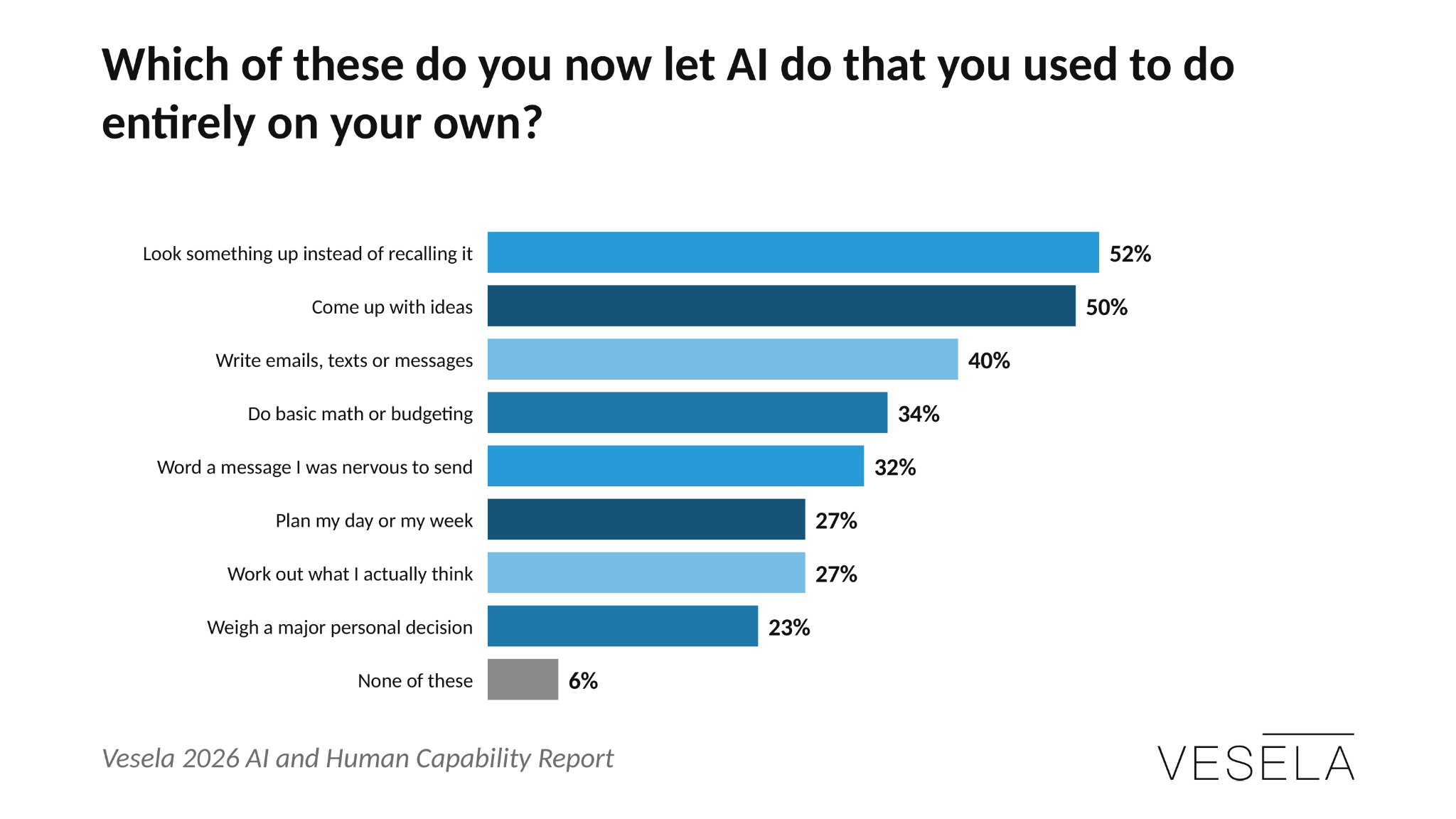
94% have handed at least one everyday task to AI that they used to do entirely themselves. Of the eight everyday tasks respondents were asked about, the typical person has handed three over to AI.
Among the lightest users, those who have handed over one everyday task or none, 22% have skipped learning something new because they say AI can do it for them. That rises to 42% among people who have handed over two to five tasks and reaches 58% among the heaviest users, those who have handed over six or more.
Overall, 38% have chosen not to learn something because AI could do it, and another 21% considered it but learned the skill anyway. By age, 58% of Gen Z have skipped learning something against 28% of Gen X.
The qualities people most fear losing to AI are creativity (38%) and independent thinking (38%), well ahead of curiosity and communication at 25%.
AI Has Moved Into Personal Relationships and Family Conflict
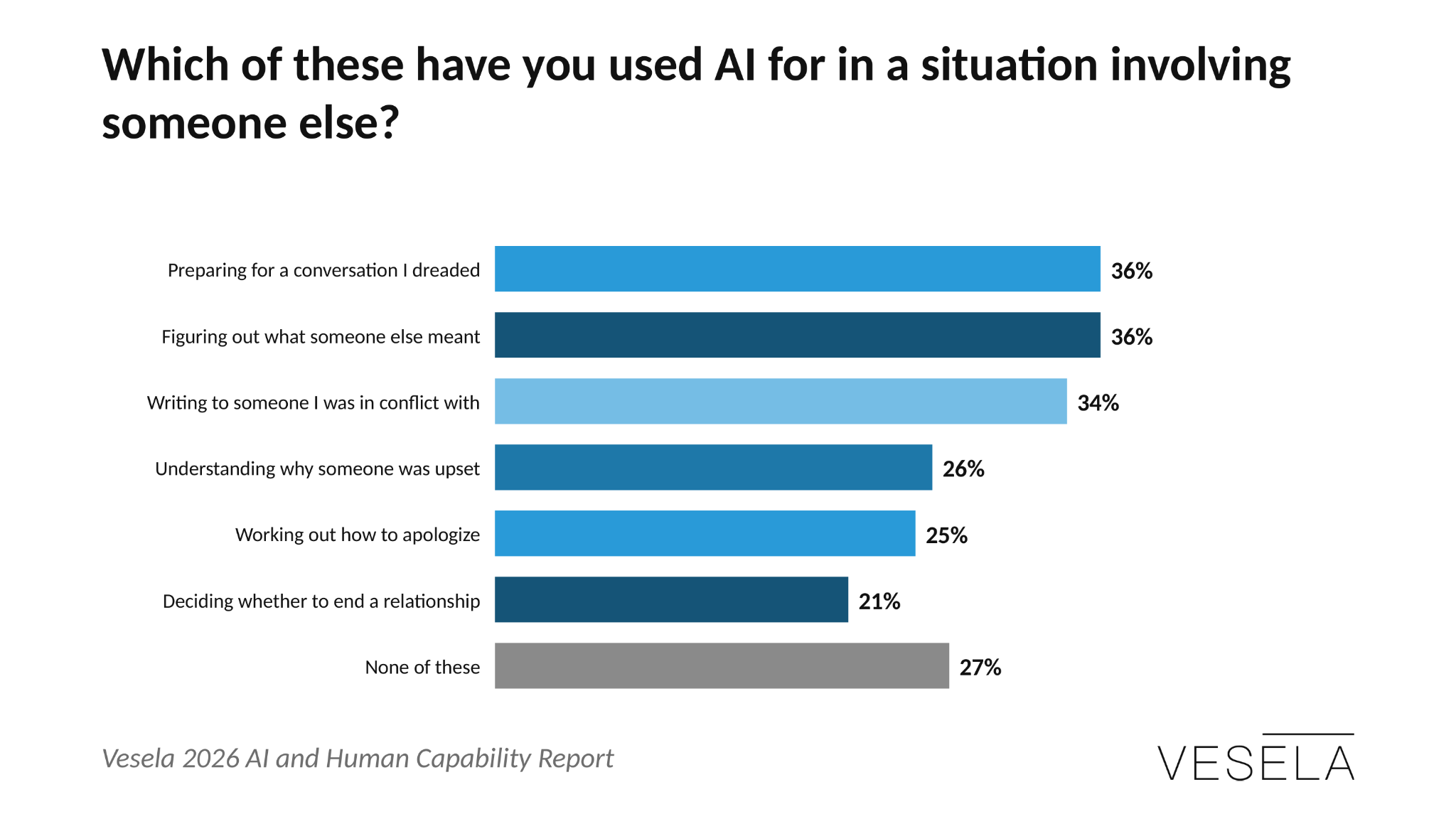
73% of daily AI users have used AI for something involving another person in their life.
Source: Vesela 2026 AI and Human Capability Report
The most common personal uses of AI are preparing for a conversation they dread (36%), figuring out what someone else actually meant (36%), and writing a message to someone they are in conflict with (34%).
26% have used AI to understand why someone was upset with them, 25% to work out how to apologize, and 21% while deciding whether to change or end a relationship. Using AI for something involving another person is most common among Gen Z, at 87%, then 79% of Millennials and 62% of Gen X.
“I’m having a conflict with my brother about taking my niece to a wedding, and I asked for advice on how to help him see he’s being unreasonable.” — Survey Respondent
“I’ve asked AI if I should end a relationship with a toxic person, giving it all the details.” — Survey Respondent
“I asked AI to help me understand why my adult children don’t appreciate me.” — Survey Respondent
The people who use AI in their own relationships are also the most bothered when it is used on them. 83% would object to finding out someone had used AI for a personal matter like an apology or condolence message to them, against 65% of people who never use AI this way. Among people who have used AI to work out their own apology, 45% say they would be bothered to receive one.
An AI-written apology bothers the most people (36%), followed by a condolence message (32%) and the decision of who to hire for a job (31%).
The Most Common Complaint About AI Is That It Goes Along With People
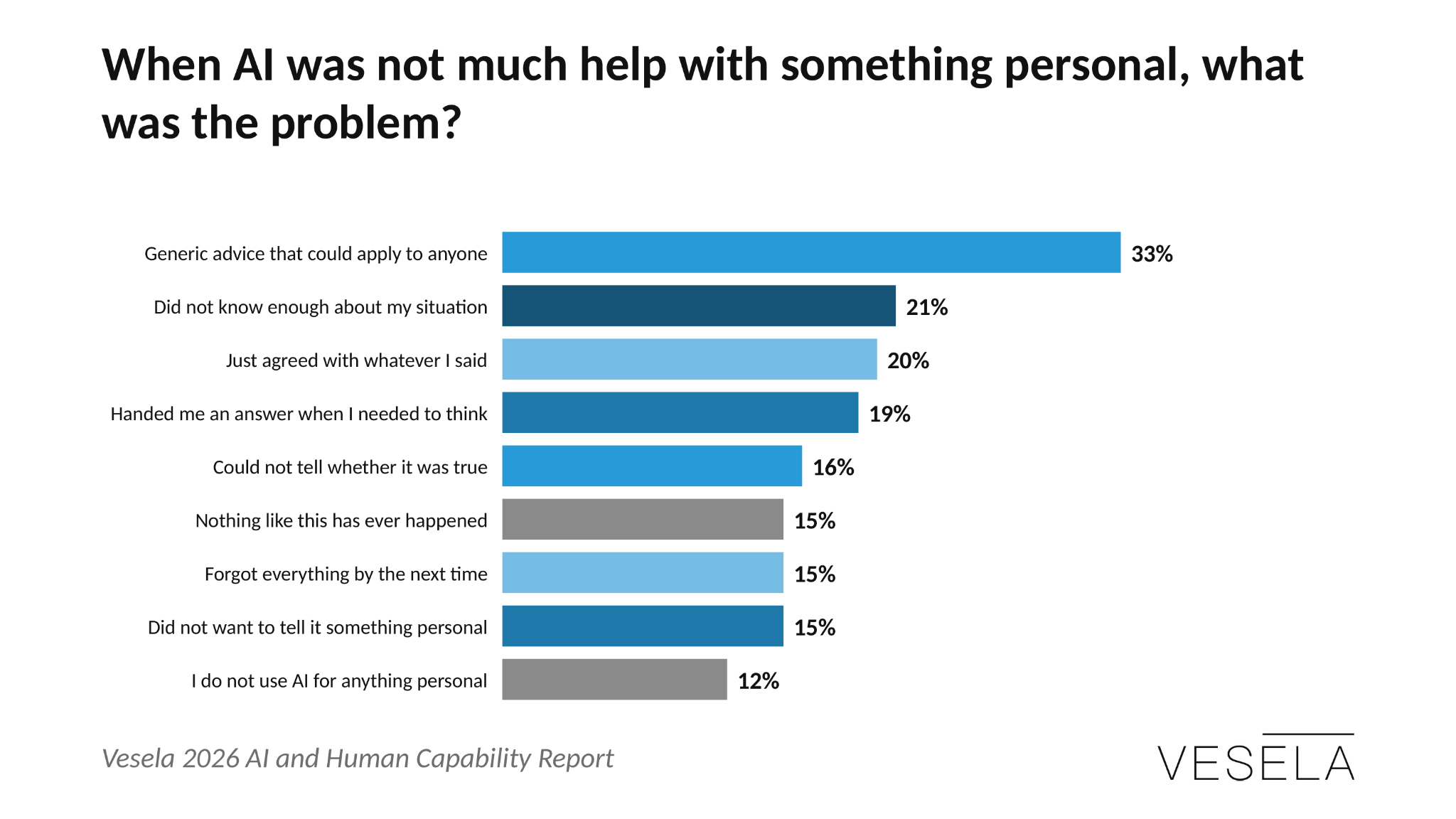
53% of daily AI users say that when AI was no help with something personal, it went along with them instead of engaging them.
Source: Vesela 2026 AI and Human Capability Report
53% of users say that when AI was no help with something personal, it was because the AI went along with them instead of engaging them. That 53% covers three related complaints: generic advice that could apply to anyone (33%), simply agreeing with whatever they said (20%), and handing over an answer when they needed to think it through (19%).
When facing a decision with no single right answer, 63% want AI to help them work through it without telling them what to do. That includes 37% who want it to lay out the options and let them decide, and 26% who want it to ask questions until they figure out what they think. By comparison, just 14% want AI to outright tell them what it thinks they should do.
50% want something more or different from AI than what it does today, compared to 36% who say what they use AI for is pretty much all they want.
People Want an AI That Makes a Teenager Work for the Answer
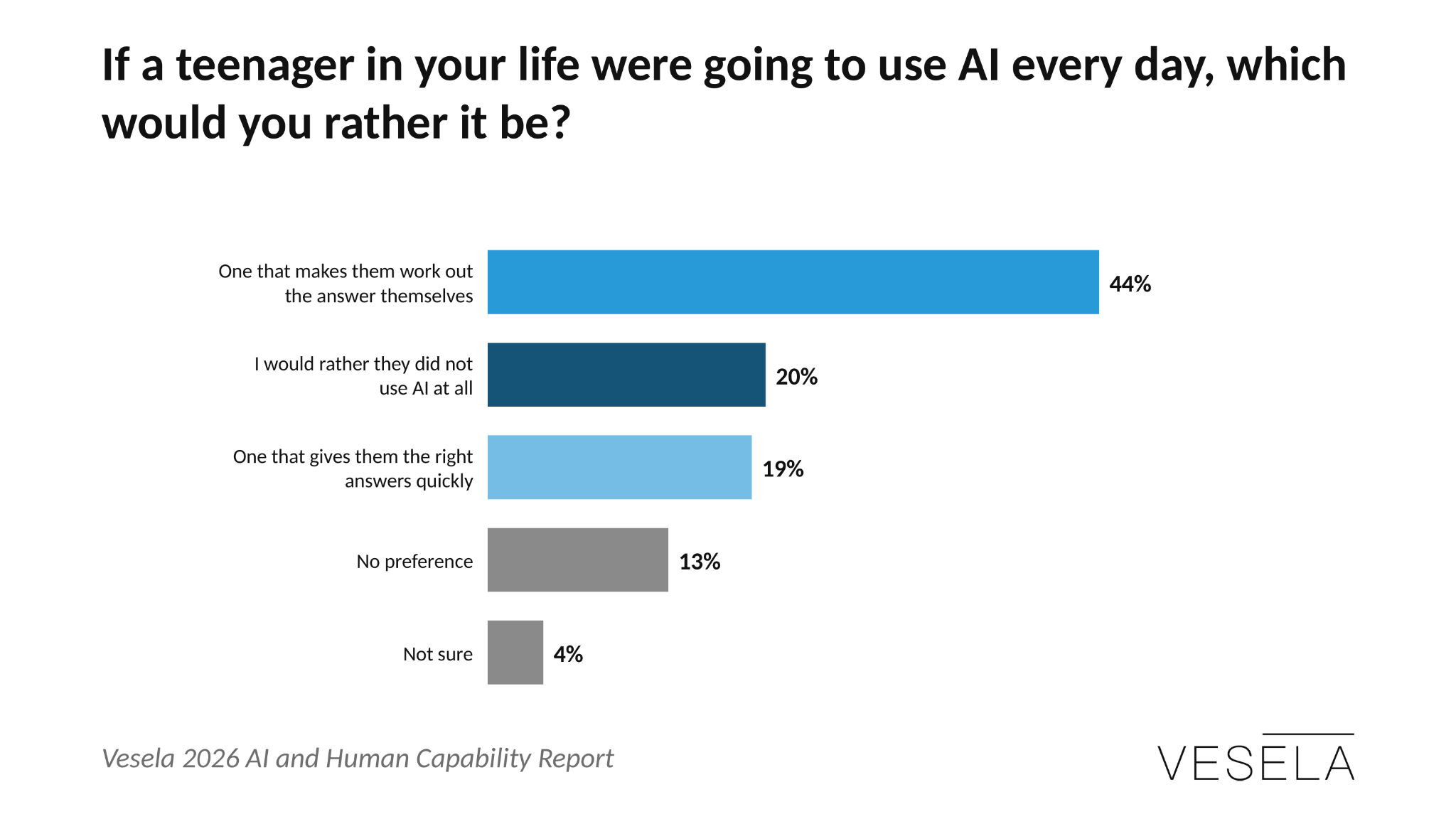
Only 19% of daily AI users would want a teenager in their life using an AI that gives quick answers.
Source: Vesela 2026 AI and Human Capability Report
44% would rather a teenager in their life use an AI that makes the teen work out the answer, even when it is slower. 20% would rather a teenager not use AI at all. Only 19% would choose the quick-answer AI for a teen.
Most People Expect to Be More Capable in Five Years
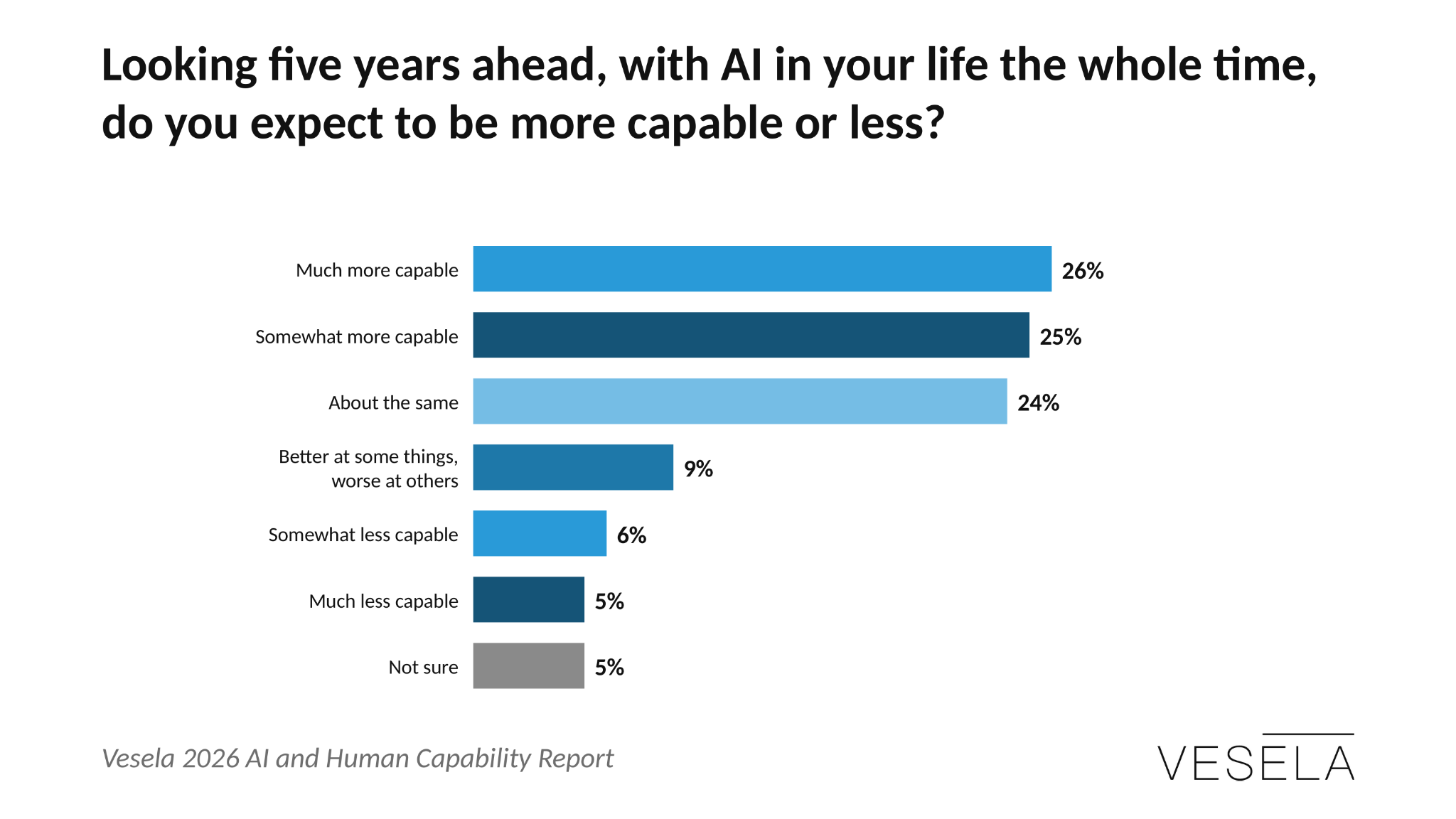
51% of daily AI users expect to be more capable in five years with AI in their lives the whole time. 11% expect to be less capable.
Source: Vesela 2026 AI and Human Capability Report
Looking five years out, with AI in their lives the whole time, 51% expect to be more capable than they are today, and 11% expect to be less capable. That optimism is stronger among people whose AI has challenged their thinking. Among those whose AI has prompted them to reconsider something, 60% expect to be more capable in five years, compared with 44% of those whose AI has never done so.
“Look at what the big labs benchmark themselves on: math, coding, science. Impressive metrics though they are, it’s simply not the lane occupied by most people. The average person wants career achievement, to be better with their family, better in their community, and those involve questions that don’t have a mathematically accurate right answer waiting. No matter how much you type into a prompt, a model is never going to have the context of your entire life and that lifetime of context is critical to you, and only you, remaining the top candidate to author your life.
“The risk isn’t that people get bad answers, though this is possible. The risk is that if something solves your problems for long enough, your ability to perform this task atrophies like an unused muscle. There is no replacement for repetition. No shortcut to agency. My hope for humanity is that people come away from conversations with human aligned AI trusting their own thinking more, not less.”
— Chase Chick, Founder & CEO, Gray Sky AI
Frequently Asked Questions About AI and Human Capability
How are people using AI to make personal decisions?
According to the Vesela 2026 AI and Human Capability Report, 70% of people involve AI at least sometimes when working through a personal decision. 15% usually turn to AI but sometimes involve people, while 13% work through the decision with AI and rarely involve another person at all. By comparison, 14% talk it through with people and never with AI.
How does the way AI engages with people relate to how they perceive their own thinking?
Among people whose AI has prompted them to reconsider something, 76% say their thinking has gotten sharper, compared with 48% of those whose AI has not challenged their thinking. The same group is also more likely to name a real change in themselves, 93% compared with 68%. These findings show an association, not a proven causal relationship.
Does handing more everyday tasks to AI relate to skipped learning?
Yes. Of the eight everyday tasks respondents were asked about, the typical person has handed three over to AI. Among people who have handed over one task or none, 22% have skipped learning something because AI could do it for them. That rises to 42% among those who have handed over two to five tasks and 58% among those who have handed over six or more.
What are people most worried about losing as AI takes on more tasks?
Creativity and independent thinking rank highest, with 38% naming each. Curiosity and communication follow at 25%.
How are people using AI in their relationships and personal lives?
73% have used AI for something involving another person. The most common uses include preparing for a difficult conversation and figuring out what someone else meant, both at 36%. 21% have used AI while deciding whether to change or end a relationship.
How do people feel about receiving AI-written personal messages?
An AI-written apology bothers 36% of respondents, followed by a condolence message at 32%. People who use AI in their own relationships are also more likely to object to receiving AI-assisted personal communication, at 83% compared with 65% of people who never use AI this way.
What do people want AI to do when there is no single right answer?
63% want AI to help them work through the decision without telling them what to do. That includes 37% who want it to lay out the options and let them decide and 26% who want it to ask questions that help them figure out what they think. By comparison, just 14% want AI to tell them what it thinks they should do. Half also say they want something more or different from AI than what it does today.
Why do people say AI falls short on personal problems?
53% say that when AI was no help with something personal, it went along with them instead of engaging them. That includes generic advice that could apply to anyone at 33%, simply agreeing with whatever they said at 20% and handing over an answer when they needed to think it through at 19%.
What kind of AI do people want teenagers to use?
44% would rather a teenager use an AI that makes them work out the answer, even when it is slower. Another 20% would rather the teenager not use AI at all. Just 19% would choose an AI that gives the teen quick answers.
Do people expect AI to make them more capable over time?
51% expect to be more capable in five years with AI in their lives, while 11% expect to be less capable. That optimism is stronger among people whose AI has prompted them to reconsider something: 60% expect to be more capable, compared with 44% of those whose AI has never done so.
Try Vesela
Vesela is designed to help you think through problems and arrive at your own answers.
Related Articles

Before You Ask AI About Them
73% of daily AI users have used AI for something involving another person in their life. Here is how to use it to get clear, then say it in your own words.

Does Your AI Just Agree With You?
53% of daily AI users say that when AI was no help with something personal, it went along with them instead of engaging them.

Character.AI Alternative: Talk to Vesela Free With Voice-to-Voice Conversations
If you are searching for a Character.AI alternative, you may not be looking for another chatbot with a different logo.