Before You Ask AI About Them
Chase Chick · October 16, 2026

73% of daily AI users have used AI for something involving another person in their life. Here is how to use it to get clear, then say it in your own words.
It is 11pm. You have typed and deleted the same text to your brother four times. Or you are replaying something your manager said and trying to decide whether it meant what you think it meant. So you open an AI chat and start typing.
If that sounds familiar, you have a lot of company.
Meet Vesela. Start your first conversation.
App Store | Google Play
Most daily AI users already bring other people into the chat
In our Vesela 2026 AI and Human Capability Report, a survey of 800 Americans who use an AI chatbot every day for personal reasons, most had already used AI for something involving another person.
73% of daily AI users have used AI for something involving another person in their life.
Source: Vesela 2026 AI and Human Capability Report (Pollfish, n=800 U.S. daily AI users, Sep 2026)
Using AI for something involving another person is most common among Gen Z, at 87%, then 79% of Millennials and 62% of Gen X.
What people are actually using AI for
The uses are not exotic. They are the moments most of us know well.
The most common personal uses of AI are preparing for a conversation they dread (36%), figuring out what someone else actually meant (36%), and writing a message to someone they are in conflict with (34%).
Source: Vesela 2026 AI and Human Capability Report (Pollfish, n=800 U.S. daily AI users, Sep 2026)
Beyond those, 26% have used AI to understand why someone was upset with them, 25% to work out how to apologize, and 21% while deciding whether to change or end a relationship.
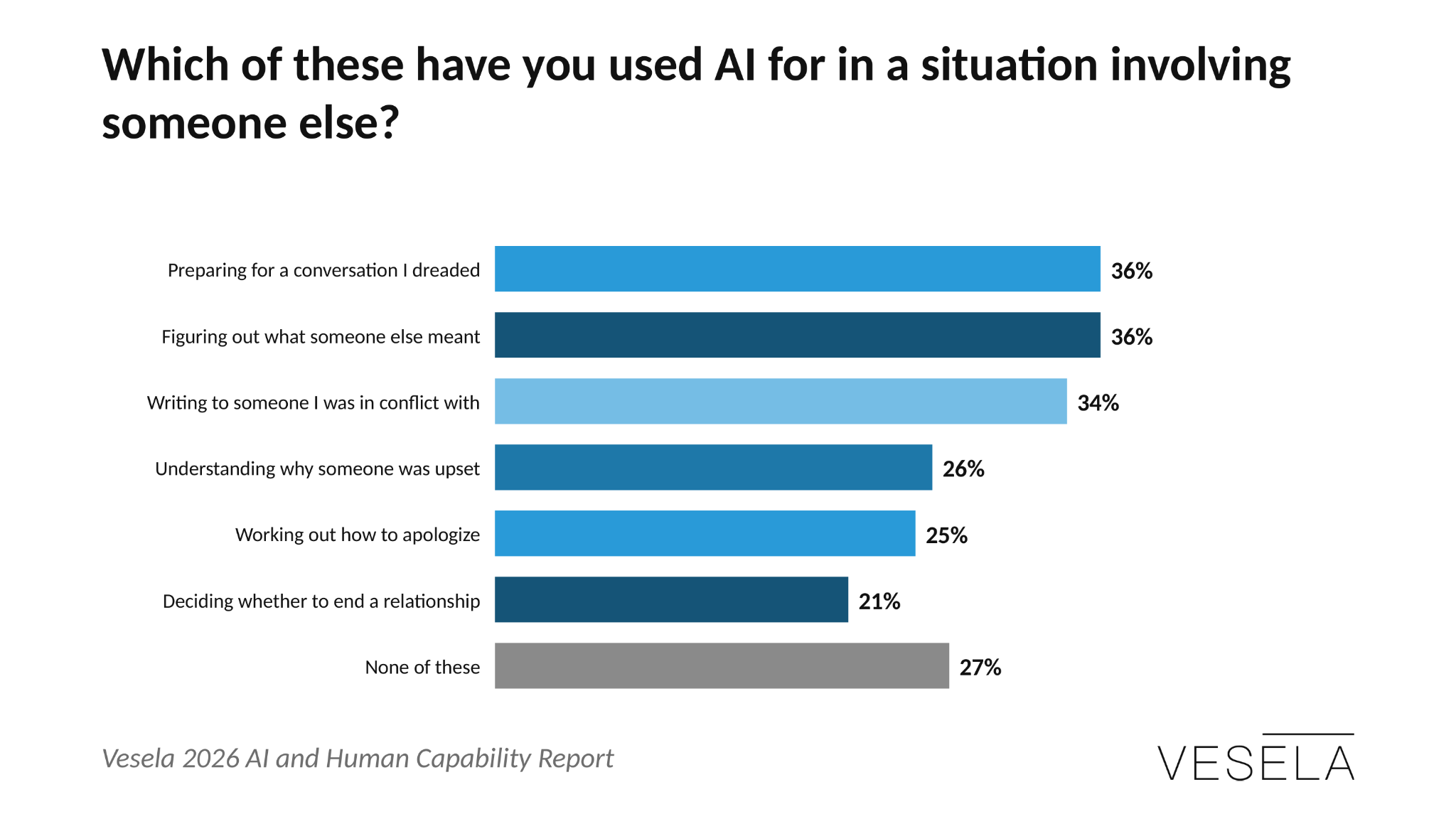
We do not read that list as a warning sign. We read it as people trying. Rehearsing a hard conversation, checking whether you misread a text, figuring out how to say sorry: those are signs someone cares enough to get it right.
AI can be genuinely useful for that kind of preparation, especially at 11pm when nobody else is awake.
The double standard says something good about us
Here is where it gets interesting. We also asked how people would feel on the other side of the message.
83% of people who use AI in their own relationships would object to finding out someone had used AI for a personal matter like an apology or condolence message to them, against 65% of people who never use AI this way.
Source: Vesela 2026 AI and Human Capability Report (Pollfish, n=800 U.S. daily AI users, Sep 2026)
You could call that hypocrisy. We think it is something more hopeful. The people who use AI most in their relationships know exactly what it can and cannot do, and they still want the words that reach them to come from a person. Using AI to prepare is one thing. Letting it speak for you is another.
That is why our team at Gray Sky AI built Vesela as an AI thought partner. It asks questions so you reach your own answer instead of being handed one: what happened, what you want the other person to understand, and what you are willing to own. Then the words you send are yours. Voice mode is free, so you can talk it through out loud the way you would with a friend.
Talk it through before you say it. Meet Vesela. Start your first conversation.
App Store | Google Play
The messages people least want from a machine
People are clear about which moments matter most.
An AI-written apology bothers the most people (36%), followed by a condolence message (32%).
Source: Vesela 2026 AI and Human Capability Report (Pollfish, n=800 U.S. daily AI users, Sep 2026)
An apology and a condolence note have something in common. Their value is that they cost you something: time, thought, a little discomfort. When that cost is outsourced, the message can feel hollow, even if every word is perfect.
Get clear with AI, then say it yourself
None of this means you should keep your relationships out of AI chats. It means using AI for the right job:
- Rehearse, do not outsource. Use AI to practice the hard conversation, then have it yourself.
- Ask what you are missing. “Why might they have been upset?” is a better prompt than “Write me a reply.”
- Keep the final words yours. If it is an apology or a condolence note, write it in your own voice, even if it comes out imperfect.
Imperfect and yours will usually land better than polished and borrowed. You can explore all the findings in the full Vesela 2026 AI and Human Capability Report.
FAQ
Should I use AI for relationship advice?
Many people already do. 73% of daily AI users have used AI for something involving another person in their life. It can help you prepare and get clear, while the conversation itself stays yours.
Do people mind receiving an AI-written apology?
Many do. An AI-written apology bothers the most people (36%), followed by a condolence message (32%).
Source: Vesela 2026 AI and Human Capability Report (Pollfish, n=800 U.S. daily AI users, Sep 2026)
Vesela: AI Thought Partner is on the App Store and Google Play, and voice mode is free.
Meet Vesela. Start your first conversation.
App Store | Google Play
Related Articles

Does Your AI Just Agree With You?
53% of daily AI users say that when AI was no help with something personal, it went along with them instead of engaging them.

AI Might Not Come for Your Job, but it Might Be Coming for Your Judgment
76% of daily AI users whose AI has challenged their thinking say it made their thinking sharper, against 48% of those whose AI has not.

Character.AI Alternative: Talk to Vesela Free With Voice-to-Voice Conversations
If you are searching for a Character.AI alternative, you may not be looking for another chatbot with a different logo.